
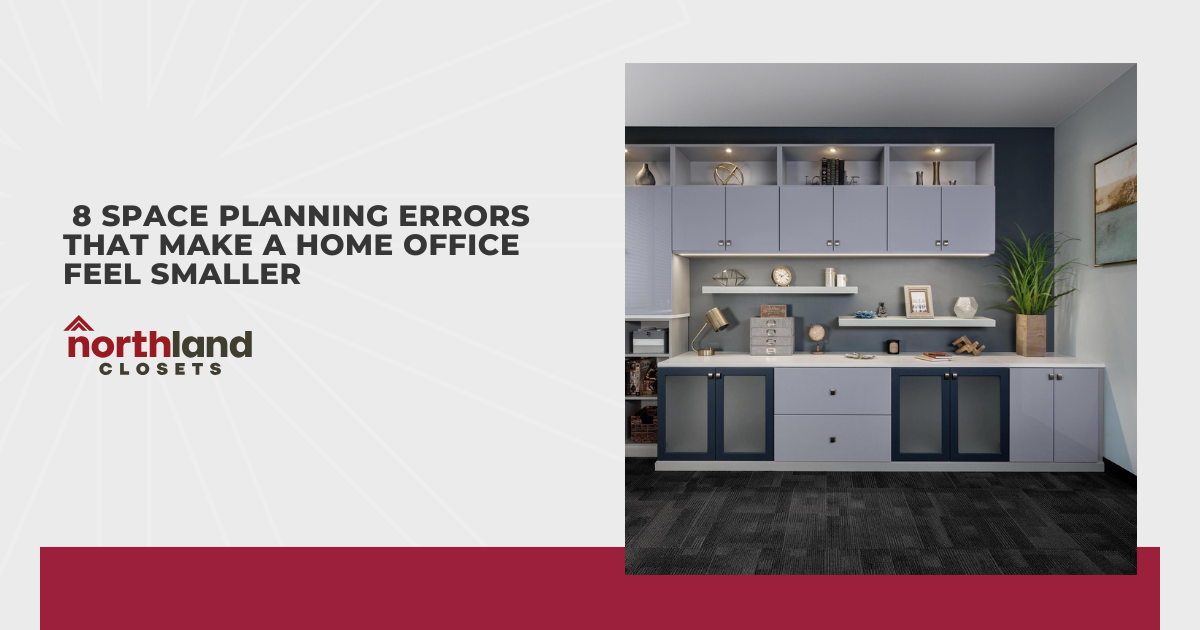
A home office doesn’t have to be tiny to feel cramped. In my work, I’ve seen plenty of rooms with decent square footage that still feel crowded, cluttered, and hard to work in. Often, it’s not because the homeowner has too much stuff. It’s because of a few space planning mistakes that quietly steal comfort and breathing room.
In most cases, you can fix these issues without a renovation or expensive furniture. Small layout adjustments can make your home office feel instantly larger, brighter, and more functional. When your desk, storage, and pathways are planned intentionally, the room starts working for you instead of against you.
Here are the most common space planning errors that can make a home office feel smaller than it really is:
- Pushing the desk into the worst possible spot
- Using a desk that’s too deep or too wide for the room
- Ignoring clearances (chair space + walkways)
- Relying on bulky storage furniture instead of vertical storage
- Letting cords, printers, and tech create visual clutter
- Placing too many small pieces instead of fewer functional ones
- Using poor lighting placement (and missing task lighting)
- Choosing the wrong layout for the room shape
If your home office feels tight, don’t worry. As you read through each space planning error, you’ll start recognizing what may be making your office feel smaller, along with simple changes to fix it.
Pushing the Desk Into the Worst Possible Spot
One of the biggest reasons a home office feels smaller is poor desk placement. It’s common to push the desk into a corner or against a wall without thinking about how the room flows, and that can create awkward dead space and make the entire office feel closed in. I always remind clients that the desk is the anchor of the room, so its placement matters more than almost anything else.
A desk shoved into the wrong spot can block walkways, reduce natural light, and make the room feel tight even if it’s technically “organized.” When you sit down to work, your eye line and the surrounding open space affect how comfortable the room feels. If possible, reposition your desk to preserve clear pathways and maximize sightlines. Sometimes even a small shift makes the room feel noticeably bigger.
Using a Desk That’s Too Deep or Too Wide for the Room
Oversized desks are a surprisingly common home office problem. People often choose a desk based on style or surface area without checking whether the proportions suit the room, and a big desk can dominate the floor plan. When furniture overwhelms the space, the room loses balance and feels more cramped.
A desk can be too large even if it looked perfect in the store. If your chair barely clears the wall behind you or you have to squeeze past the desk to access other areas, it’s a sign the desk is taking more space than it should. In smaller rooms, a slimmer desk, wall-mounted option, or narrow writing desk can keep the space functional without shrinking it visually.
Ignoring Clearances (Chair Space + Walkways)
Even a tidy home office can feel cramped when you can’t move comfortably. A common space planning mistake is arranging furniture without leaving enough clearance for chair movement and walkways, which makes daily use feel awkward and restricted. People often focus on fitting items in rather than planning how they’ll actually work in the space.
Your chair needs room to slide back, turn, and move without bumping into walls or storage. Walkways matter too, especially if your home office shares space with a guest room or includes a closet you need to access regularly. I like to plan clear paths first and then place furniture around them, because open movement is one of the quickest ways to make a room feel larger.
Relying on Bulky Storage Furniture Instead of Vertical Storage
Storage is essential in a home office, but how you store things makes a huge difference. One of the biggest space planning errors I see is relying on wide, heavy furniture, like big bookcases or filing cabinets, that eat up floor space. These pieces can make a room feel visually heavy and smaller than it is.
When storage sits low and wide, your eye stays at ground level, which can make the room feel shorter and more crowded. Instead, look for vertical storage solutions like tall shelving, floating cabinets, and wall-mounted organizers. When storage goes up instead of out, your home office tends to feel more open and intentionally designed.
Letting Cords, Printers, and Tech Create Visual Clutter
Tech clutter is one of the sneakiest reasons a home office feels smaller. Cords, chargers, power strips, and printer accessories create visual noise, and even when everything is “put away,” tangled wires can still make the room look messy. And when a space looks messy, it almost always feels smaller.
Printers can be another big contributor, especially when they become the center of a catch-all station for paper stacks and supplies. A simple fix is creating one contained tech area and managing cords intentionally with clips, sleeves, or cord boxes. When tech looks tidy and streamlined, your home office instantly feels calmer and less crowded.
Placing Too Many Small Pieces Instead of Fewer Functional Ones
Another space planning mistake I see often is “furniture clutter.” A home office might have a desk, plus a small cart, plus a side table, plus an extra chair, each one added to solve a small problem. Over time, those mini pieces create a choppy layout that makes the room feel crowded and disjointed.
This usually happens gradually, which is why it’s so common. Instead, aim for fewer pieces that do more, like a desk with drawers that replaces a cart or wall shelving that replaces a floor unit. When you simplify the furniture footprint, the room feels more spacious and easier to maintain.
Using Poor Lighting Placement (and Missing Task Lighting)
Lighting affects how big a room feels, and it’s often overlooked in a home office. Many people rely only on overhead lighting, which can create harsh shadows and leave corners dim. Dark areas make a space feel smaller and less inviting, even if the layout is solid.
Improving lighting is one of the easiest “invisible upgrades” you can make. Try layering your lighting with a desk lamp for task lighting and a floor lamp to brighten darker corners. When lighting is balanced, the room feels more open, energized, and comfortable to spend time in.
Choosing the Wrong Layout for the Room Shape
A home office layout should match the room’s shape, not fight it. One mistake I see is forcing a standard setup into a room that isn’t built for it, like trying to center a large desk in a narrow room or cramming symmetrical storage into a tight corner. When the layout doesn’t fit the space, the office ends up feeling awkward and cramped.
Long narrow rooms, small square rooms, and shared-use spaces all need different layout strategies. Sometimes the best option is a corner desk setup, while other times a floating desk works better than pushing everything to the walls. If your office feels tight, step back, measure the room, and test a few layout options. The right layout can make the room feel bigger without changing the square footage.
Conclusion
A home office feels more spacious when the layout supports how you actually work, regardless of the room’s size. When you right-size the furniture, protect your walkways, and reduce visual clutter, the space naturally feels calmer and more open. If you take just one idea from this list and apply it this week, you’ll likely feel the difference right away. And honestly, that “ahh, I can breathe in here” feeling is exactly what a home office should give you.
